


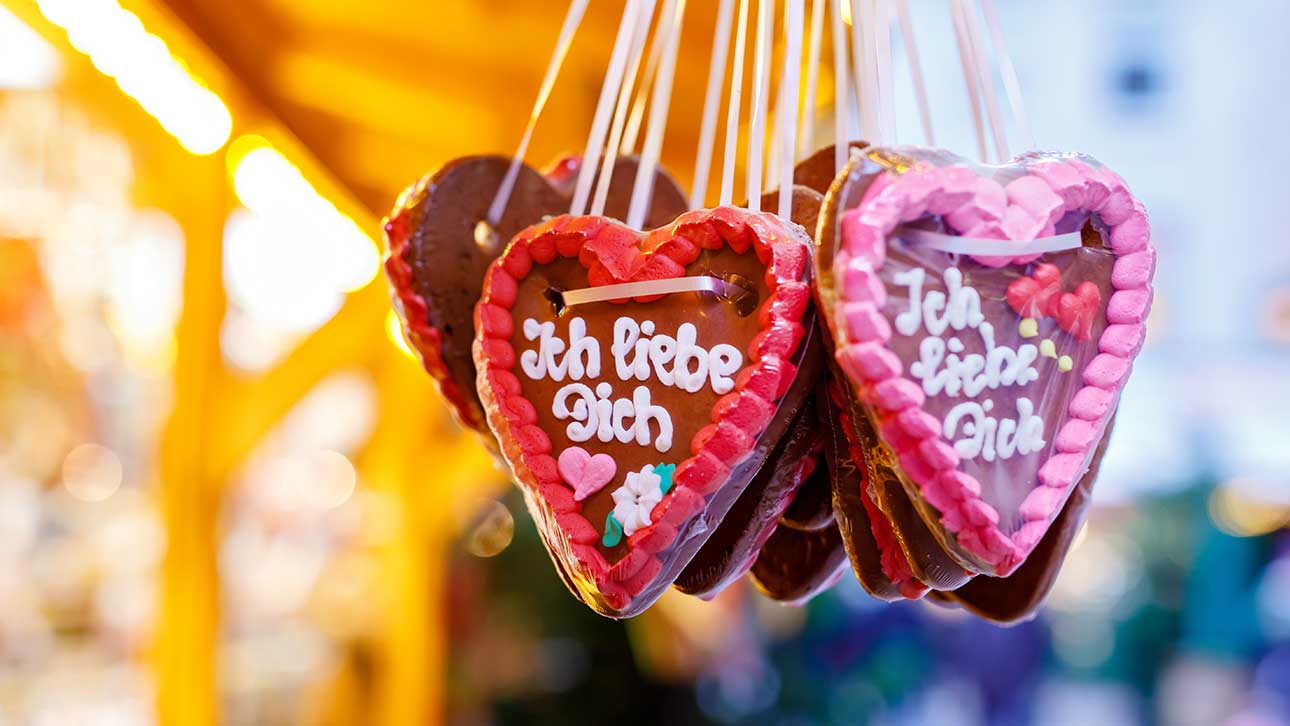
Amid the scent of grilled sausages and mugs of smooth beer, among laughter, music, and countless smiles, one thing at Oktoberfest has never changed over the centuries — the gingerbread hearts. These colorful, handmade sweets symbolize love, friendship, and human warmth. They are the very heart of the festival — both literally and emotionally.
Imagine Munich during Oktoberfest or Stuttgart during Cannstatter Wasen: the air smells of caramelized sugar, the brass bands play “Ein Prosit,” and people wear brightly decorated gingerbread hearts around their necks. Some read “Ich liebe Dich,” others “Für Dich,” or simply “Prinzessin.” Anyone who has been there knows — these hearts aren’t bought to be eaten. They’re bought to say something words cannot. And perhaps that’s why they’ve become the sweetest language of Bavaria and Baden-Württemberg.
Advertisement
What do gingerbread hearts symbolize at Oktoberfest?
Gingerbread hearts symbolize love, affection, and human connection — a simple yet profound gesture through which Bavarians express warmth and gratitude. They embody the spirit of Oktoberfest — a celebration where people share joy and the scent of spices becomes a language of emotions. To give a gingerbread heart means to show sympathy, appreciation, or simply good cheer — without words, but with a gesture that lasts.
Beneath the colorful icing lies more than a souvenir — it’s a piece of Bavarian soul, a way of expressing emotion through a handmade symbol. People buy them to give away and to keep as mementos. Each heart is a small message of kindness, baked with tradition and flavored with love — a living symbol of Bavaria that endures to this day.
How did the tradition of gingerbread hearts begin in Germany?
The tradition of gingerbread hearts began long before the first Oktoberfest. In the 15th century, German monks mixed honey, flour, and spices such as ginger, cinnamon, and cloves to make a fragrant bread believed to have healing properties. Thus was born Lebkuchen — the ancestor of today’s gingerbread hearts. In Nuremberg and Augsburg, bakers turned this craft into an art form — cutting shapes, decorating them with icing, and selling them at fairs as tokens of affection and good wishes.
By the time Munich hosted its first Oktoberfest in the 19th century, gingerbread hearts were already part of the tradition. They weren’t just sweets, but expressions of emotion — small symbols that outlast the festival itself.
Advertisement
What does it mean to give a gingerbread heart at Oktoberfest?
Giving a gingerbread heart at Oktoberfest means expressing love, affection, or gratitude in the most Bavarian way — through a gesture rather than words. In Bavaria, this sweet gift is seen as a sign of attention and kindness. When someone gives you a gingerbread heart, it’s an invitation to closeness, a symbol of respect, or even a playful flirtation. At the festival, it’s like a personal note written in icing instead of ink.
This tradition endures because it carries humanity within it. Boys give them to girls, friends exchange them as keepsakes, and children wear them proudly around their necks. Every inscription — from “Ich liebe Dich” to “Für Dich” — is a tiny sentence of emotion. And perhaps that’s why, amid thousands of beer mugs and songs, a gingerbread heart remains the most genuine symbol of joy and affection.
How are traditional Bavarian gingerbread hearts made?
Authentic Bavarian gingerbread hearts are made by hand, following an age-old recipe preserved through generations — with honey, ginger, cinnamon, cloves, and plenty of patience. It’s a craft where every step matters: the dough is kneaded, baked slowly, and carefully dried until it develops its signature aroma and firmness. Each heart is then cut to shape, and the moment of true magic follows — hand-decorating with colorful icing.
Confectioners use piping bags to create fine ornaments and write short, personal messages such as “Ich mag dich,” “Du bist mein Schatz,” “Süße Versuchung.” Everything is made by hand, so no two hearts are ever the same. The scent of spices and honey mingles with the festive sounds of Munich, turning these hearts into little works of art that carry the taste and spirit of Bavaria.
Advertisement
How did gingerbread hearts become a symbol of love and marketing?
Gingerbread hearts became both a symbol of love and a marketing phenomenon because they blend emotion and tradition in a way that never goes out of style. Originally handcrafted tokens of affection, they evolved into a cultural emblem of Bavaria — carrying not just sweetness but history. Bakers and producers soon realized these weren’t ordinary confections but a universal language of positive feeling — a product bought with emotion, not habit.
Today, gingerbread hearts are everywhere — shared on Instagram, customized with company logos, and sold in countless shapes and colors. Yet their charm remains intact. Behind every inscription and swirl of icing lies a human story — a smile, a gesture, a festive memory. And perhaps that’s why, even in the digital age of marketing, these hearts continue to be bought not as commodities, but as symbols of something genuine and heartfelt.
Advertisement
Why do people keep their gingerbread hearts after Oktoberfest?
People keep their gingerbread hearts because they hold memories — of the festival, of emotion, and of the person who gave them. Each heart is a souvenir of a moment you want to preserve: the scent of beer and spices, the laughter, the music, that fleeting instant when life felt simple and full of joy. A gingerbread heart is a symbol of happiness you don’t want to let go of.
When Oktoberfest ends, the city quiets down, but the hearts remain — hanging on walls, resting on shelves, or attached to the backpacks of travelers from around the world. Over time they harden, yet their aroma and the memories they hold stay alive. And when, months or years later, someone looks at one, that night in Munich comes rushing back — the songs, the lights, and that simple message written in icing: “Ich liebe Dich.”
What makes gingerbread hearts an enduring symbol of Bavarian culture?
Gingerbread hearts have become an enduring symbol of Bavarian culture because they unite three timeless elements — tradition, emotion, and human connection. They carry the flavor of history, the art of craftsmanship, and the warmth of a gesture that speaks louder than words. Over the centuries, they’ve grown into a cultural icon of Bavaria — at once a souvenir, a love token, and a living legend linking generations.
Their timelessness lies in their ability to convey feeling through the simplest means — shape, color, and aroma. In an age of constant change, gingerbread hearts remain a bridge between past and present. They preserve the Bavarian spirit — warm, welcoming, and sincere — reminding us that true tradition never fades when it’s baked with love.








Comments (0)
No comments yet.