
![Български [BG]](/media/mod_languages/images/bg_bg.gif "Български [BG]")
![English [EN]](/media/mod_languages/images/en_gb.gif "English [EN]")
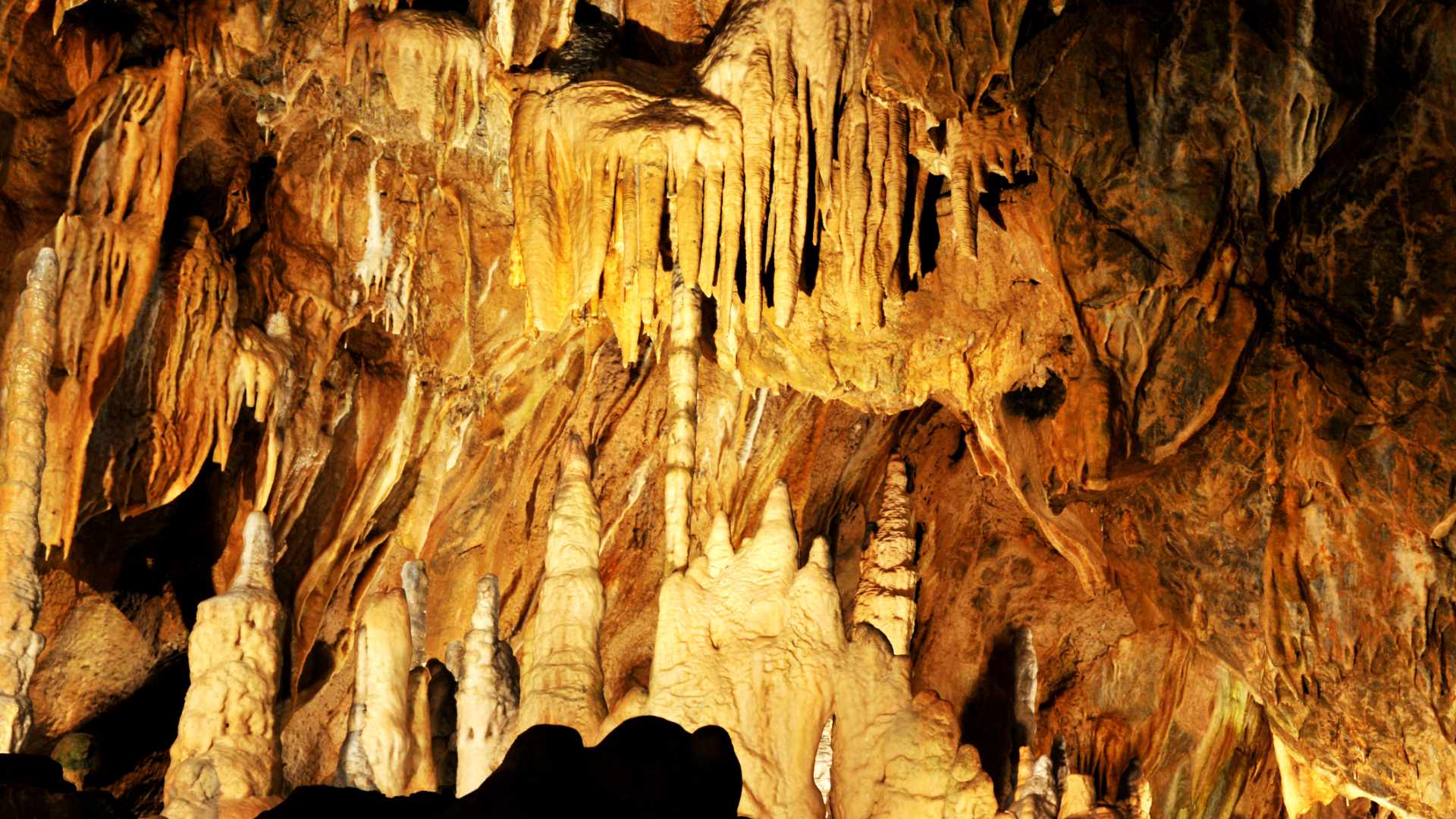
When you hear the word "cave," you probably picture a dark passage, cool air, and stalactites hanging from the ceiling. But did you know that in Germany, you can take a boat ride along an underground river, see ice formations in the middle of summer, or find yourself surrounded by rock formations that resemble enormous stone curtains? Beneath the surface are places that look nothing like the caves most of us are familiar with.
It all started with an intriguing map of Germany. It showed the country's show caves, but instead of the usual symbols for natural attractions, there were five different color-coded categories. At first, it seemed to be a simple classification of five cave types. A closer look, however, revealed some fascinating geological differences behind those categories.
The map distinguishes between karst and gypsum caves, rock caves and caves with underground streams, caves with dripstone formations, primary caves, and other underground formations. This is a thematic classification designed to present tourist attractions, rather than a universal scientific classification. A karst cave, for example, can contain stalactites, an underground river, and ice formations all at the same time.
In Germany, caves developed for public visits are known as Schauhöhlen, or show caves. According to the German Speleological Federation (Verband der deutschen Höhlen- und Karstforscher), there are 53 such caves in the country. Some feature illuminated walkways, others can only be explored with a guide, and a few require a reasonable level of physical fitness. If you enjoy natural attractions, Germany offers plenty of opportunities to discover what lies beneath its familiar mountains and hills.
Karst and Gypsum Caves in Germany: How Does Water Create Vast Underground Spaces?
Water is one of the most important forces behind cave formation. As it seeps through cracks in certain types of rock, it gradually dissolves minerals and widens the spaces between them. Over long geological periods, this process can create underground passages, galleries, and enormous chambers. These processes are characteristic of karst landscapes, where soluble rocks such as limestone, dolomite, gypsum, and rock salt are found.
One particularly interesting example is Barbarossahöhle, near Rottleben in Thuringia. The cave is located in the Kyffhäuser Mountains and is famous for its unusual gypsum formations. In some areas, curved sheets of rock hang from the ceiling, resembling large pieces of fabric or animal hides left out to dry. These formations are actually the result of the mineral anhydrite absorbing water and transforming into gypsum. This process increases the rock's volume, gradually causing thin layers to separate from the surrounding surface.
Barbarossahöhle takes its name from Emperor Frederick I Barbarossa, a historical figure surrounded by numerous German legends. The cave was discovered by accident in 1865 by miners searching for copper ore and began welcoming visitors shortly afterward. If you enjoy destinations that combine natural history with local folklore, this is certainly one cave worth exploring.
Stalactite and Stalagmite Caves: Where Can You See Germany's Most Beautiful Dripstone Formations?
These are probably the most recognizable types of caves. In German, they are called Tropfsteinhöhlen, and their defining features are mineral formations created by water seeping through the surrounding rock. Stalactites form on cave ceilings and grow downward, while stalagmites build up on the floor and gradually rise upward. When the two formations meet, they create a cave column, also known as a stalagnate.
The process is slow. Water carries dissolved minerals that, under the right conditions, are deposited, most commonly as calcite. Some formations have developed over thousands of years, while others are considerably older. Their growth rates depend on the amount of water, its mineral composition, temperature, and conditions inside the cave itself.
Among Germany's best-known examples is Attahöhle in Attendorn, North Rhine-Westphalia. Another impressive option is Teufelshöhle near Pottenstein in Bavaria. If you're traveling through the Harz Mountains, Baumannshöhle and Hermannshöhle in Rübeland are also worth considering. Both are well-known attractions in the region, offering guided tours through caves filled with a variety of dripstone formations.
During your visit, take time to notice the smaller details, not just the towering stalactites. Delicate calcite formations and subtle mineral colors can be just as interesting as the enormous underground chambers. And resist the temptation to touch the formations, even when they appear sturdy. Their surfaces are sensitive to contamination, and any damage can remain visible for a very long time.
Rock Caves and Underground Rivers: Where in Germany Can You Explore a Cave by Boat?
Not every cave forms in the same way, and not every cave is explored on foot. Some underground spaces are associated with faults and fractures in the rock, while others still contain flowing streams. On the German map, these features are grouped together, although from a geological perspective, rock fractures and the presence of underground water describe different characteristics of caves.
One of Germany's most unusual show caves is Wimsener Höhle, also known as Friedrichshöhle. It is located near Hayingen in Baden-Württemberg, in the Swabian Jura region. This is the only active water cave in Germany that visitors can enter by boat. The boat tour covers approximately 70 meters (230 feet), after which the cave ceiling becomes so low that ordinary boat travel is no longer possible.
That's exactly what makes Wimsener Höhle so interesting. Instead of following an illuminated footpath, you board a small boat and gradually travel deeper into the rock. The underground stream, reflections on the water, and low cave ceiling create an atmosphere quite unlike an ordinary sightseeing excursion.
Another example is Goetz-Höhle, near Meiningen in Thuringia. This tectonic cave features cracks and fissures formed by movements and shifts within the rock mass. During a visit, you pass through narrow, towering rock passages that reveal an entirely different process of underground cavity formation.
If you're planning a trip to Wimsener Höhle, keep in mind that the cave operates on a seasonal schedule. It generally does not welcome visitors during the winter months, so check opening hours and ticket availability before your visit.
Primary Caves: How Can a Cave Form at the Same Time as the Surrounding Rock?
Most familiar caves formed after the rock surrounding them was already in place. Geologists classify these as secondary caves. In primary caves, however, the cavities develop at the same time as the surrounding rock itself. Similar processes occur when lava tubes form in volcanic regions, although primary underground spaces can develop in other ways as well.
One particularly interesting example in Germany is Olgahöhle in Honau, Baden-Württemberg. The cave is formed in calcareous tufa, a porous carbonate rock created when calcium carbonate precipitates from water. As these deposits accumulated, natural cavities remained between them, eventually forming the underground passages visible today. Calcareous tufa should not be confused with volcanic tuff, as the two materials have entirely different geological origins.
Olgahöhle is known for its unusual dripstone formations, some of which resemble cauliflower. The cave was discovered in 1874 during quarrying operations, and in 1884, it became the first show cave in Germany to be equipped with electric lighting. At the time, this was a significant technological achievement, allowing visitors to experience the underground world in an entirely new way.
If you've only explored traditional karst caves, Olgahöhle offers an interesting opportunity to understand why geologists also classify caves according to when they formed. Their appearances may sometimes be similar, but the geological stories behind them can be completely different.
Ice Caves in Germany: How Can Ice Survive Even During the Summer?
The fifth category on the map includes other caves that do not fall neatly under the previous labels. Among the most fascinating examples of unusual underground conditions are ice caves. There's an important distinction here: an ice cave is not necessarily a hollow space formed inside a glacier. In many cases, it is a natural cave in solid rock where low temperatures and specific patterns of air circulation allow ice to accumulate and remain for extended periods.
One such example is Schellenberger Eishöhle in Bavaria, near Berchtesgaden. Located in the Untersberg mountain massif at an elevation of approximately 1,570 meters (5,150 feet), the cave is known for its ice formations and underground chambers. Even when summer temperatures prevail outside, conditions inside allow ice to survive throughout the year.
Visiting a cave like this requires more preparation than a typical sightseeing tour. Reaching the entrance involves a mountain hike, so sturdy footwear, appropriate clothing, and a reasonable level of physical fitness are essential. The cave itself is also cold, and visitors move along secured pathways and stairways.
Important: As of October 2026, Schellenberger Eishöhle is closed to visitors for safety reasons. The operator is working toward a possible reopening for the 2027 season. If you're considering including it in a future trip, check the latest information on the cave's official website.
Which Caves in Germany Are Suitable for Visiting With Kids?
If you're looking for a family outing, show caves can be an interesting option, especially if your children already enjoy exploring natural attractions. For a first visit, we'd consider Attahöhle, Teufelshöhle near Pottenstein, or the caves in Rübeland. Their organized tours provide an opportunity to learn about cave formation without needing specialized equipment for a caving expedition.
For older children who are comfortable climbing stairs and aren't bothered by heights or enclosed spaces, Laichinger Tiefenhöhle in Baden-Württemberg could be particularly exciting. It is Germany's only publicly accessible vertical shaft cave. The visitor route passes through large underground spaces and descends metal staircases to a depth of 55 meters (180 feet) below the entrance. It's an unusual experience, but it isn't suitable for everyone, particularly visitors with limited mobility.
Whichever cave you choose, bring a warm outer layer and shoes with good traction. Underground temperatures are often significantly lower than those outside, and steps can be damp. Check in advance for age restrictions, reservation requirements, and tour duration. Some German show caves operate seasonally, while others close during the winter to protect hibernating bats.
Which Caves in Germany Are Worth Adding to Your Next Trip?
If you've only visited caves filled with stalactites and stalagmites, consider exploring something different on your next trip. The gypsum formations of Barbarossahöhle, the underground boat ride at Wimsener Höhle, and the unusual calcareous tufa of Olgahöhle reveal just how varied the natural processes beneath the Earth's surface can be.
You don't need to plan an entire vacation around a single cave. Many of these destinations can easily be combined with visits to nearby towns, castles, nature parks, and hiking trails. If you're traveling through the Swabian Jura, the Harz Mountains, Thuringia, or Franconian Switzerland, it's worth checking whether there's a show cave nearby that deserves a few hours of your day.
Perhaps the most interesting thing about caves is that they reveal a part of nature we rarely get to see. After visiting one, even an ordinary rocky hillside along the road can look a little different, because you now have a better idea of the remarkable spaces that might be hidden beneath it.



















Comments (0)
No comments yet.