


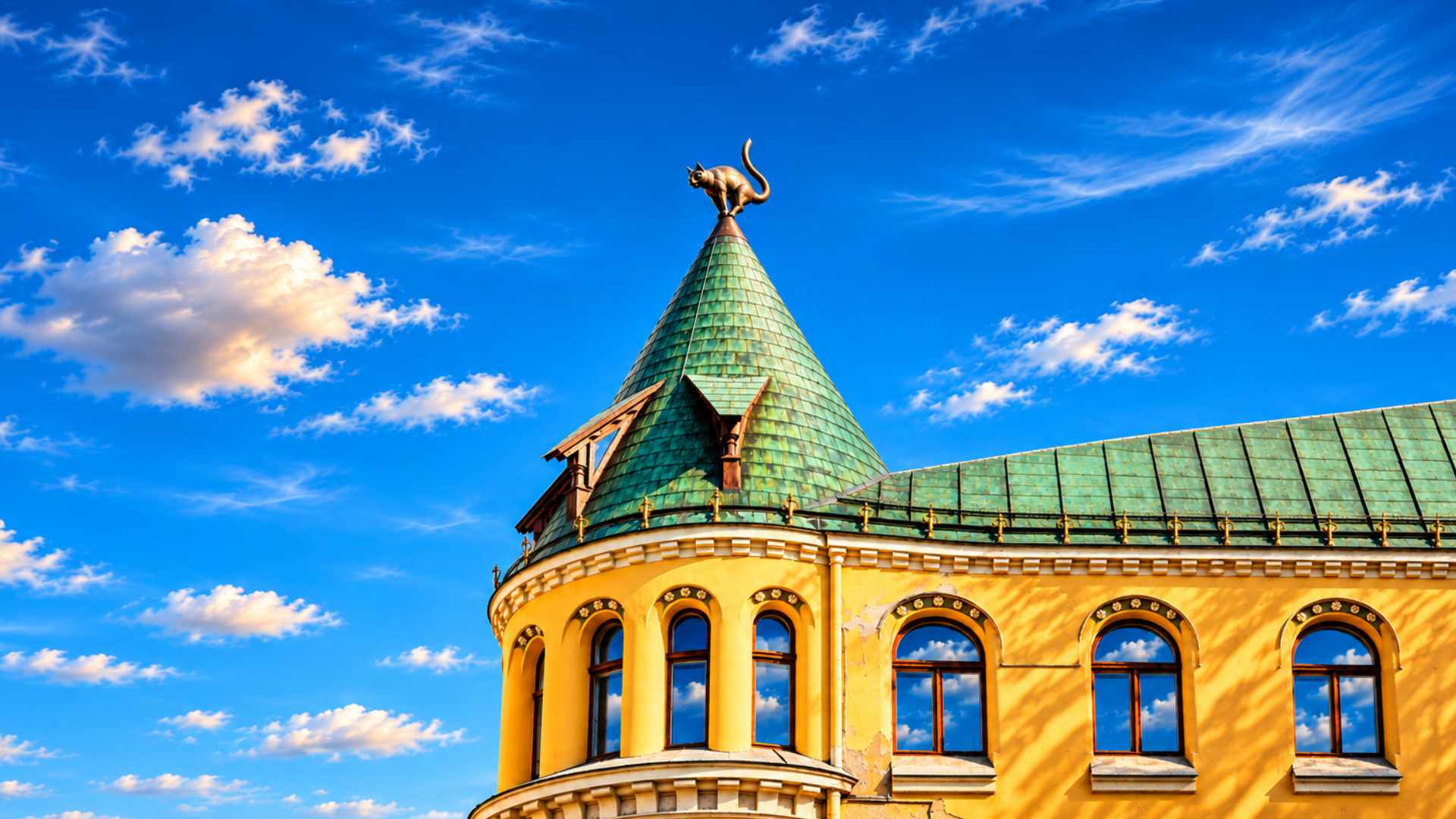
Hello! Whether by chance or by choice, you've found your way to Dany B. Bold's Travel Journal, my personal column in Travel Inspiration Magazine. As you've probably guessed, I'm Dany B. Bold, and today I'll try to tell you about two cats I haven't been able to get out of my head since my walk through downtown Riga this morning. Don't ask how or why I ended up here. That's another story. What's more interesting is that these particular cats haven't taken a single step to earn their fame.
Want to know what I discovered in Riga's Old Town, not far from Līvu Square (Līvu laukums)? A beautiful building with a yellowish facade and two pointed green towers. Perched atop each one is a metal cat with an arched back and its tail held high. This is the famous... well, of course... Cat House (Kaķu nams), built in 1909. I'll admit, it was the architecture that first caught my eye, but the cats quickly stole my attention. And once I learned their story, there was no way I could just walk past them.
Advertisement
Why the Cat House, of All Places?
It all began in the early 20th century, when Riga was an important trading center and membership in the Great Guild brought prestige and influence. According to local stories, a wealthy Latvian merchant wanted to join the organization but was turned down. The gentleman was not particularly pleased. Fortunately for him, he owned a house directly across from the guild and, as you might have guessed, decided to make the most of that advantage.
He commissioned two metal cats and ordered them placed on the roof, with their raised tails pointing toward the guild's windows. Instead of writing angry letters, he let the cats express his opinion. Around the clock. I'll admit, that's quite an interesting approach. Especially considering his neighbors had no way of missing the message.
Did Two Cat Tails Really End Up in Court?
According to the most popular version of the story, the guild members were so offended that they filed a lawsuit. The merchant was ordered to turn the cats in another direction. Another version claims he was finally accepted into the organization and voluntarily turned the figures around as a gesture of reconciliation. There are also accounts suggesting that the dispute was actually with the city authorities rather than the guild. As you can see, these two cats have quite a few versions of their own past.
While looking through Latvian publications, I discovered that the historical evidence behind this famous act of revenge is far from conclusive. Local sources connect the building to a merchant named Jānis Plūme, who was involved in the wine trade. Some researchers suggest that the nature of his business may have been what prevented him from joining the guild. The cats are real, but the story of the offended merchant remains unresolved. Which, between you and me, is a little disappointing. I was already looking forward to reading a court record devoted to the direction of two cats' tails.
Advertisement
And What's Beneath Those Green Roofs?
With all this talk about the story, I nearly forgot to tell you about the building itself. The Cat House was built in 1909 and designed by architect Friedrich Scheffel. Its two pointed towers resemble those of a medieval castle, while the facade is decorated with floral ornaments, geometric patterns, and decorative masks. The architecture combines historical influences with elements of Art Nouveau, also known as Jugendstil. In person, the contrast between the green roofs and yellowish walls is especially appealing.
And speaking of Riga, the city has plenty to offer architecture lovers. Its historic center was added to the UNESCO World Heritage List in 1997, and its rich Art Nouveau heritage is one of the reasons visitors come from around the world. If you have some extra time, I'd also recommend Alberta Street (Alberta iela), where you'll find magnificent early 20th-century facades. But back to our cats. As it turns out, their story doesn't end with the alleged dispute between the merchant and the guild.
Did the Cats Disappear from the Roof?
Now, here's something that surprised me. The cats I saw this morning aren't the original figures from 1909. According to a historical article published by the Latvian outlet Press.lv, they were removed in 1951 on the orders of Kārlis Plaude, who was then a senior official at the Latvian Academy of Sciences. At the time, the building housed a research institute, and the figures were considered inappropriate for the dignity of an academic institution. Apparently, the cats continued to have trouble with influential organizations, regardless of the political climate.
One figure was damaged during removal, while the other was stored for a time in the cloister of Riga Cathedral before eventually disappearing. The two towers remained without their most famous residents for decades. Later, sculptor Ināra Gulbe created new copper figures using old photographs, and according to the same publication, the cats returned to their places in 1980. Fortunately, no one objected to their presence this time.
Advertisement
Where Can You Find the Cat House in Riga?
If you decide to look for it, the address is Meistaru iela 10, near Līvu Square in the Old Town. The Great Guild stands across from it, so you can decide for yourself just how convincing you find the story of the offended merchant. For a good photo, step back a little from the facade so you can capture the green tower, the cat, and part of the building in the same frame. The second cat sits atop the other tower, so take a look at the roof from a few different angles.
The Cat House itself isn't a museum and is mainly admired from the outside. But the surrounding area is full of beautiful streets, interesting architecture, and inviting places to stop for coffee. I certainly wouldn't rush to leave. Especially now that I know what happened to the cats over the years. Watching them becomes a lot more interesting once you know their story.
Advertisement
One of the Cats Even Made the Cover of Travel Inspiration Magazine
By the way, you've probably already spotted one of the cats on the cover of the November issue of Travel Inspiration Magazine. Yes, it's the very same figure I've been telling you about. I loved the way it stood out against the green tower, but after learning more about the building, I decided it deserved a story of its own in the magazine.
I'll admit, I had no idea this morning how much time I'd end up spending on these two cats. I had completely different plans for my walk through Riga. But now, as I write these lines from a nearby café, I'm still smiling at the thought of that wealthy merchant and his unusual way of expressing his displeasure. Whether the story is true, we'll probably never know for certain. And I think I've already picked my favorite version.
I'll leave you here for now. Riga is waiting, and I still have a few streets I'd like to explore. Particularly in the direction of the Bremen Town Musicians sculpture, near St. Peter's Church. By the way, one of those four musicians happens to be a cat, too. I'm starting to suspect there's no escaping cat stories today.
And perhaps I'll make one more stop for coffee.
Dany B. Bold





Comments (0)
No comments yet.